Capacitive level sensors for standard applications
Capacitive sensors are often used for level measurement - but they are often prone to errors.
The sensors are strongly influenced by environmental factors such as temperature fluctuations, humidity or electrical interference. These variables affect the precision and reliability of the measurements.
Replace your capacitive sensors with universal measuring devices from MBA Instruments! These offer you the reliability and precision you need.
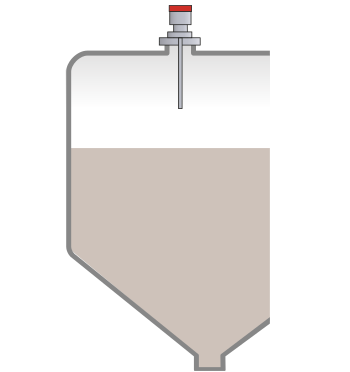
Principle of measurement of level sensors without media contact
The principle of capacitive level measurement is based on the capacitance of an electrical capacitor formed by a liquid medium and the wall of the tank. The capacitive sensor in the medium and the tank wall form a capacitor whose capacitance depends on the amount of medium in the tank. A change in capacitance caused by a change in level is converted into a level signal.
If the probe is in the air, a certain low initial capacitance of the capacitor is measured. When the container is filled, the capacitance of the capacitor increases as the probe is covered. Once the previously defined capacitance has been reached, a limit signal is emitted. For commissioning, the measured capacitance must be assigned to the percentage level. This adjustment is carried out by measuring the capacitance when the tank is empty and when it is full.

The method is most suitable for bulk solids with a sufficiently high dielectric constant, which means that products with a low dielectric constant are more difficult to measure, including those with a low density.
The measurement sensitivity of the sensor may need to be customised to take into account the specific properties of the product in question. Changes in the product, such as changes in moisture, may require the sensor to be re-adjusted to ensure accurate measurements.
That's why we at MBA Instruments have developed measuring devices for point level measurement that can be used flexibly for any application and can withstand the challenges.
Our universal fill level measuring devices such as rotating paddle detectors, vibrating level switches or membrane switches are designed to provide the versatility and precision required in complex environments.

In the field of grain and flour processing, a simple and reliable solution for level measurement tasks is required. Determining the fill level in closed, non-transparent containers, such as a silo, is necessary in order to be able to place repeat orders in good time and thus avoid production bottlenecks.